

Demo vs. Production: How AI Agents Power Real Product Success
Quick Answer: AI agents are software systems that go beyond traditional chatbots by understanding user intent, planning tasks, and taking real-world actions. AI agents can use tools, call APIs, access data, and execute multi-step workflows. In production environments, AI agents rely on structured architectures, orchestration strategies, guardrails, and human oversight to ensure reliability, safety, and scalability.
Many product teams are experimenting with chatbots that could retrieve documents and answer simple questions. The AI ecosystem is moving insanely fast and today it has matured to a point where agents can take actions, use tools, and orchestrate multi-step workflows across entirely different domains.
But the distance between a compelling demo and a reliable production system remains wider than most expect. Closing that gap requires deliberate choices around architecture, orchestration, tool design, safety, and the role of humans in the loop. The frameworks that follow come from building multi-agent systems that serve millions of users every month, handling everything from IT support and HR queries to learning recommendations, document generation, and meeting bookings. These are the practical scaffolding that turns autonomous agents into trusted products.
What is an AI Agent Anyways
A traditional chatbot takes a query, finds information and produces text. It’s conversational and basically reactive. An AI agent goes many steps beyond that. It understands the user’s intent, plans multi-step workflows, calls APIs, queries databases, runs code, acts on behalf of the user. It is functional, not merely conversational.
This operational layer has five properties.
- First of all, autonomy. An agent decides based on goals and context, without needing constant human guidance.
- Secondly, tool use. It connects to external systems, pulls live data, and does real world actions like booking a meeting or updating a record.
- Third, the planning. Agents decompose complex tasks into steps, and they modify those steps when intermediate results don’t match expectations.
- Fourth, memory. They remember the history of conversations and learn from previous interactions so that they can personalize and get better.
- Fifth, teamwork. And agents can collaborate with other specialized agents, cooperating to solve problems that no one agent can solve by itself.
Take as an example an AI agent that helps a user to book a flight. It searches for options, presents them, and makes the booking. The multi-agent system solves something more ambitious, like planning a team offsite. The coordinator agent sends messages to a calendar agent to search for dates, a vendor agent to search for locations, a budget agent to check costs, and an email agent to send invitations. Each step in the workflow is carried out in a domain that provides the right tools and context for a specialized agent. The multi-agent model is capable of handling complexity that would overwhelm a monolithic system.
Read more about AI agent’s impact in manufacturing.
Choosing an Architecture That Matches Your Complexity
Not every problem needs a sprawling multi-agent system. The architecture you choose determines the complexity, scalability, and maintainability limits.
Single-agent (monolithic) architectures perform well for well-defined tasks in a single domain where the requirements on tools are limited. They are simple to build, have low latency and are easy to debug. The tradeoff is a single point of failure and limited scalability. An FAQ chatbot with document retrieval fits here.
In multi-agent systems, work is divided among specialized agents. Each agent is responsible for a different domain or toolset. They scale well because adding a new capability means adding a new agent, not complicating existing logic. You get better fault isolation but higher coordination overhead and debugging complexity. This pattern is used by an enterprise assistant routing HR, IT and finance queries to different domain agents.
Hierarchical architectures add a coordinator agent that receives requests, detects intent, routes work to the appropriate domain agents, and aggregates responses. This design supports clear separation of concerns and efficient routing of tasks. The coordinator can become a bottleneck, with the quality of its routing logic determining overall success. It is a good medium between control and scalability. Many big production systems end up here.
Collaborative (peer-to-peer) architectures allow agents to negotiate and solve problems without a central coordinator. They are very flexible and robust to individual failures. However, their behavior may be unpredictable and hard to control. It may be used by research agents working together on complex analysis. The hierarchy model works well for most product teams in terms of control and growth.
How Agents Work Together: Orchestration Strategies
Once you commit to multiple agents, the central design question is how they hand off work to each other. Five orchestration patterns cover most real-world use-cases.
In a sequential (pipeline) flow, the output of one agent becomes the input of the next agent until a result is reached. This works when each step builds on the previous one, e.g. an intent detection agent feeding a routing agent that dispatches to a domain agent.
Parallel (fan-out/fan-in) orchestration involves sending a request to several agents in parallel and subsequently aggregating the results. It is good for independent subtasks where speed is important. A search query might be sent in parallel to a web agent, a database agent and a document agent, and an aggregator might combine the findings.
Conditional (decision tree) routing uses a decision agent to examine the input and route it down a particular path. An example of this model is an intent classifier that sends HR questions to an HR agent, and IT questions to an IT agent.
Iterative (loop) flows allow an agent to process input, check for validation, and retry if the result falls short. This refinement loop is especially important for tasks like code generation where a validator can find errors and send the agent back to fix them.
Most production systems end up with a hybrid approach that stitches several of these patterns together. A typical request might look like: sequential intent detection, conditional routing by a coordinator, parallel execution across domain agents, sequential aggregation of responses, and iterative clarification when confidence is low. The rule of thumb is to begin with the customer journey and select the orchestration that best supports the actual workflow.
Tools Turn Agents Into Operational Systems
An agent without tools is just a clever conversationalist. Tools are the functions and APIs that allow agents to fetch information, act, do computations, and integrate with business systems. They close the gap between coming up with a plausible response and doing something useful in the real world.
Tools fall into four categories: information retrieval (search, lookup, and query), action execution (create, update, delete, and send), computations (calculate, analyze, transform) and integration (connections to CRM, communication platforms and enterprise systems). Five questions guide the selection when assembling a tool suite: What can the agent do? What kind of tools are there? What are the reliability requirements? What does this mean for security? How will monitoring and maintenance be done?
Guardrails and Fallbacks Are Non-Negotiable
Agents’ actions have real consequences, financial, legal and safety related. Trust means the system should behave predictably even when things go wrong. Every layer needs to have guardrails.
Guardrails to validate user input, prevent prompt injection, filter sensitive information, and set rate limits. Guardrails for planning check the agent's planned actions before they are executed, flag dangerous actions, require approval for important decisions, and limit the range of what an agent can attempt to do. Tool guardrails check tool inputs, limit access through permissions, execute a dry mode for testing, and ask for confirmation on destructive operations. Output guardrails check final responses, filter sensitive data, check for hallucinations and ensure compliance with organizational policies.
Fallback strategies are a plan B if something goes wrong. Graceful degradation tries a backup agent before issuing a clear error message to the user. When the confidence drops below a threshold human-in-the-loop kicks in. The most conservative choice is the default of safety and the limitation is explained. Retry with exponential backoff handles transient failures and a circuit breaker prevents calling a failing service after error rates increase, falling back to a cached or default response.
A working production system that uses these patterns detects and masks personally identifiable information, validates actions before executing them, restricts access to documents through access controls, requires attribution of sources in outputs, and provides confidence scores. If the agent is unsure, then the system provides multiple options or escalates gracefully. These layers prevent major incidents, and foster the long term trust that sustains adoption.
Human-In-The-Loop is A Powerful Feature
Humans are frequently there to catch the AI if it falls. The more productive framing is that human involvement makes the system smarter over time. There are many situations where human judgment is required: in high-stakes financial or legal decisions, when the agent's confidence is low, to satisfy regulatory requirements that need an audit trail, and when feedback improves the model.
Humans and agents collaborate according to five patterns.
- Pre-approval means that the agent suggests, the human approves or rejects, and only then the agent goes ahead. This is perfect for high-stakes workflows.
- Post-review allows the agent to act first, and the human to review and correct later. This is useful for low-stakes decisions and learning loops.
- In collaborative mode the agent and human continue to work together in real time during complex problem solving.
- Escalation pushes the agent to attempt the task and if the agent fails or reaches a threshold of uncertainty it seamlessly hands off to a human.
- Oversight has a human monitor who watches agents in real time and can intervene. Useful during critical operations and training phases.
Because the user experience must be seamless, it’s important to explain the need for human involvement, reduce wait time, and give full context so the human can pick up quickly. You gain efficiency by automating the routine decisions, only having humans review edge cases, batching reviews together where it makes sense , and continually training the agent . The feedback loop is the engine that reduces human involvement over time Capture every human decision and use it to retrain and refine the agent and measure the reduction in escalations as a key success metric A permanent feature of human-in-the-loop systems is that they earn trust unlike systems that apologize for their limitations.
Practical Roadmap for Building Your First Agent
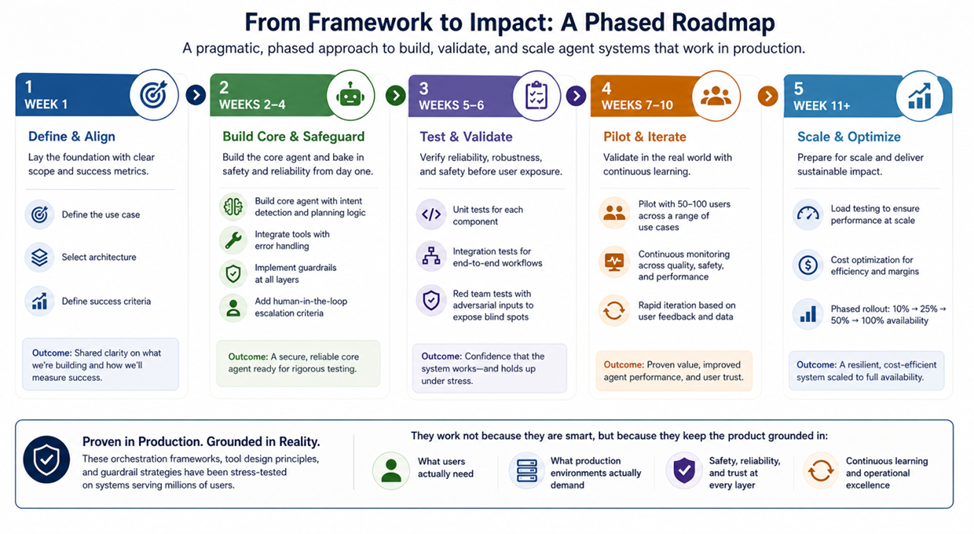
A phased approach turns the frameworks into action without over-engineering the initial launch. In the first week, define the use case, select architecture, and define success criteria. Weeks two through four focus on building the core agent with intent detection and planning logic, integrating tools with error handling, implementing guardrails at all layers, and adding human-in-the-loop escalation criteria.
Weeks five and six are for testing: unit tests for each component, integration tests for end-to-end workflows, and red team tests with adversarial inputs to expose blind spots. Weeks seven to ten run a pilot with 50-100 users across a range of use cases, with continuous monitoring and rapid iteration. Week eleven and beyond are about preparing for scale with load testing, cost optimization and a phased rollout from 10% to full availability.
The orchestration frameworks, tool design principles and guardrail strategies described here have been stress-tested on systems serving millions of users. They work not because they are smart, but because they keep the product grounded in what users actually need and what production environments actually demand.
The Takeaway
Agents are the next boundary for product teams moving from reactive chatbots to autonomous systems that plan, use tools, and take action. The right architecture fits the complexity of the problem. Single agents for simple tasks, multi-agent setup for complex domains and hierarchical patterns for most production systems. The orchestration strategy defines the smoothness of the work flow between components. Agents are powered by tools for reliability, security, and observability. Strong guardrails and fallback strategies at every layer prevent incidents and build trust. Human-in-the-loop patterns change the product from a brittle automaton to a learning system that gets better with each interaction. And that’s how you take a promising demo and turn it into a product that can handle millions of users and earn their confidence every day. Start simple, scale gradually, and monitor everything.
How Solwey Can Help
Solwey is an Austin-based software and AI innovation company specializing in enterprise AI orchestration, unified data intelligence, and custom software modernization.
Solwey helps startups and industrial midmarket companies move beyond dashboards by building secure AI agent systems that connect data warehouses to operational tools. Our solutions integrate Large Language Models (LLMs), Retrieval-Augmented Generation (RAG), and stateful multi-agent workflows to automate complex, multi-step processes.
Solwey enables organizations to eliminate data silos, enforce enterprise-grade security with SSO and RBAC, and deploy AI agents within governed environments.
By combining AI engineering, full-stack development, and enterprise security architecture, Solwey acts as a dedicated innovation partner for companies modernizing legacy systems and operationalizing AI at scale. Our team is committed to providing seamless support, ensuring that your software runs smoothly and your business runs more efficiently.
FAQ
What is a multi-agent system?
A multi-agent system consists of multiple specialized AI agents working together to solve complex problems. Each agent handles a specific domain, such as scheduling, budgeting, or communication.
When should you use a multi-agent architecture?
Multi-agent architectures are best when:
- Tasks span multiple domains or tools
- Systems need to scale with new capabilities
- Workflows require parallel or coordinated execution
For simpler, well-defined tasks, a single-agent system is often sufficient.
What are guardrails in AI agent systems?
Guardrails are safety mechanisms that ensure agents behave predictably. They include:
- Input validation and prompt filtering
- Action verification before execution
- Output checks for accuracy and compliance
They are essential for preventing errors, misuse, and security risks.
Are AI agents ready for production use?
Yes, but only with the right design. Moving from demo to production requires robust architecture, orchestration, monitoring, and fallback strategies to ensure consistent performance at scale.
YOU MAY ALSO LIKE
View all


Never miss anything!
Get weekly updates on the latest automation trends and design news.
Let's get started
If you have a vision for growing your business, we're here to help bring it to life. From concept to launch, our award-winning team is dedicated to helping you reach your goals. Let's talk.