

Vectorless RAG in AI Systems: Benefits, Limitations, and Real-World Use Cases


Quick Answer: Vectorless RAG is a retrieval‑augmented generation method that skips vector databases and embedding models entirely. Instead, it uses traditional keyword search (BM25, SQL, full‑text indexes) to fetch documents and inject them directly into the LLM’s context. It’s ideal for structured, terminology‑heavy domains (legal, healthcare, internal wikis) where cost, simplicity, and fast updates matter more than fuzzy semantic nuance.
Increasingly, teams are building retrieval-augmented generation systems without even touching a vector database. This approach, called vectorless RAG, swaps embeddings and semantic search for lexical retrieval, structured indexes, and direct context injection. It keeps the grounding power of RAG, while eliminating whole layers of cost and complexity.
The Familiar RAG Pipeline
To understand what vectorless RAG discards, it helps to revisit the classic architecture.
Retrieval-augmented generation was created to solve a fundamental limitation of large language models: they train on static data and can hallucinate when asked about facts they do not know. The standard pipeline runs through five stages. Documents pass through a chunking and embedding step where they are broken into smaller pieces and converted into numerical vectors using an embedding model. Those vectors live inside a vector database such as Pinecone or Weaviate. When a user asks a question, the system embeds the query, performs a semantic similarity search, and retrieves the most relevant chunks. The chunks then feed into the language model as context, grounding the final answer.
This workflow works.
But it also brings real operational weight. You maintain a vector database with its infrastructure costs, configuration demands, and ongoing tuning. Your embedding model must stay in sync with your retrieval step. Reindexing after any knowledge base update is slow and expensive. For teams with limited machine learning infrastructure, the overhead can feel like building a rocket to cross the street.
What Is Vectorless RAG?
Vectorless RAG is a retrieval-augmented generation approach that eliminates the vector database and the embedding layer. Instead, it uses lexical retrieval, structured indexes, or direct context injection to ground language model responses in external knowledge. You still retrieve relevant information. You still inject that information into the model’s context window. You simply skip the expensive embedding and vector search layer entirely.
Three core principles define the method:
No vector database. Rather than Pinecone or Weaviate, you use the databases your organization already runs every day: Elasticsearch, PostgreSQL with full-text search, MySQL, or even plain BM25 indexes.
No embedding step. You never call an embedding model on every document and every query. This alone removes a significant chunk of compute cost and latency.
Direct grounding. The retrieved documents are formatted and placed directly into the language model’s context window. The model generates its answer from those documents alone, making every response traceable.
The simplicity deserves emphasis because it is the main draw. Fewer components mean fewer failure points, faster iteration, and a system that any engineer who knows SQL or Lucene can debug.
Under the Hood: How Vectorless Retrieval Works
The retrieval flow is made up of five transparent steps.
1. User query. The user asks a question in natural language. Nothing to write home about.
2. Lexical or structured retrieval. Instead of embedding the query and searching a vector index, the system uses BM25, TF-IDF, keyword search, or a simple SQL query to retrieve relevant documents from a traditional text index or a relational database. Elasticsearch and PostgreSQL full-text search do this natively, and they do it battle-tested and efficiently.
3. Document ranking and filtering. Retrieved documents are ranked by a relevance score, typically BM25 scores. The system retains the top K most relevant pieces. You can optionally add a language model re-ranking step on top to refine results further without introducing a full vector layer. This hybrid lift improves quality while keeping the pipeline lean.
4. Context assembly. The selected documents are formatted and concatenated with the original query to create a structured prompt. This is the payload that is sent to the language model.
5. LLM generation. The model reads the assembled context and then outputs a response grounded on the documents retrieved. The output is specific, accurate, and auditable.
What you lose in semantic nuance, you gain in clarity. All retrievals are inspectable. You can log exactly what was returned, why it ranked, and how the prompt was constructed. No black-box similarity scores.
Six Reasons Teams Are Choosing Vectorless RAG
Lower infrastructure costs. The biggest draw for most teams. You do not pay for managed vector databases, you do not reserve GPU memory for embedding tasks, and you do not add new infrastructure. You run retrieval on systems your operations team already knows intimately.
Simpler architecture. Fewer moving parts translate directly into fewer places where things can break. There is no embedding pipeline to maintain, no index synchronization jobs to nurse, and no approximate nearest neighbor layers to tune. Operational overhead shrinks.
Faster time to market. A capable vectorless RAG prototype can appear in hours. Compare that to the days it often takes to set up a full vector pipeline with the right chunking strategy, embedding model selection, and index tuning. For rapid experiments, the speed gap is substantial.
Easy knowledge updates. For dynamic knowledge bases that change daily or in real time, vectorless RAG offers a decisive advantage. Adding a new document means inserting a row or indexing a record. The system picks it up on the very next query. No re-embedding, no reindexing lag.
Interpretable retrieval. Keyword and structured queries are auditable. When the system returns a strange result, you can examine the retrieved documents and understand exactly why they surfaced. Vector similarity scores rarely give you that clarity, making debugging a guessing game.
Works on structured data. SQL-based retrieval handles relational tables, schemas, and structured records natively. This is something vector databases were never designed to do. Financial reports, product catalogs, and compliance records all live comfortably in this world.
The Trade-Offs You Need to Know
Vectorless RAG is a tool, not a silver bullet Knowing its limits avoids expensive disillusionment.
Weaker semantic understanding. This is the basic trade off. Keyword search matches tokens, it does not understand meaning. Looking for “vehicle malfunctions” might not return any documents that use the phrase “car breakdowns.” Lexical systems leave that gap open; embeddings fill it in naturally.
Context window limits. Without a vector layer you may end up injecting more documents into the context without a surgical selection of the most semantically relevant chunks. This can overflow the token limit of the language model, especially for models with shorter context lengths.
Retrieval precision. BM25 and TF-IDF can give noisy results. Documents that contain the right keywords but are not relevant to the user’s true intent deteriorate the quality of the final answer. The higher the ambiguity the lower the signal to noise ratio.
Poor fit for unstructured data. When the corpus is highly unstructured, uses domain-specific jargon, or spans multiple languages, lexical overlap becomes unreliable. The surface patterns of words do not align with deeper conceptual connections.
Not ideal at massive scale. Full text search can be very slow when you have millions of documents without sophisticated indexing strategies. Vector search engines are more optimized for that scale of approximate matching.
Limited multi-hop reasoning. Complex questions that require reasoning across several conceptually related documents benefit from semantic similarity. Pure keyword retrieval can miss the subtle links that connect ideas across different vocabularies.
The pattern is clear: when meaning shifts beneath the words, vectorless RAG struggles. When meaning stays tightly coupled to fixed terminology, it flourishes.
Where Vectorless RAG Delivers the Most Value
Many real-world domains align almost perfectly with the strengths of lexical retrieval.
Internal knowledge bases. Corporate wikis, HR policy portals, and IT help desk systems are a sweet spot. Well structured, rich in keywords, and varies slowly between different phrasings. BM25 retrievals take care of these settings very well.
Healthcare and legal documents. Precise language is the lifeblood of legal contracts and regulatory texts. When a lawyer searches for an indemnification clause or a compliance officer needs GDPR Article 17, they want an exact match, not a fuzzy semantic approximation. Lexical retrieval delivers precisely that.
E‑commerce product search. A natural fit is matching customer queries to product catalogs stored in Elasticsearch or PostgreSQL. Product names, SKUs and categories are keyword friendly of course. As the catalog grows, retrieval remains fast, cheap and easy to maintain.
Customer support. FAQ systems and ticket solving guides work very well. It is fast, cheap and trivially updatable as the support content changes (which it does, constantly).
Financial reporting. A compelling pattern is querying structured financial tables (revenue figures, balance sheets, transaction histories) and asking a language model to generate narrative summaries. SQL is far better at retrieval than vectors could ever be.
Education and e‑learning. Vectorless RAG can quickly and cost-effectively build AI tutors that respond to student questions by pulling from course materials, syllabi and study guides.
In each case there is a common set of circumstances: structured data, precise language, frequent refreshes, or tight budget limits. When those conditions are met, vectorless RAG is often the right choice.
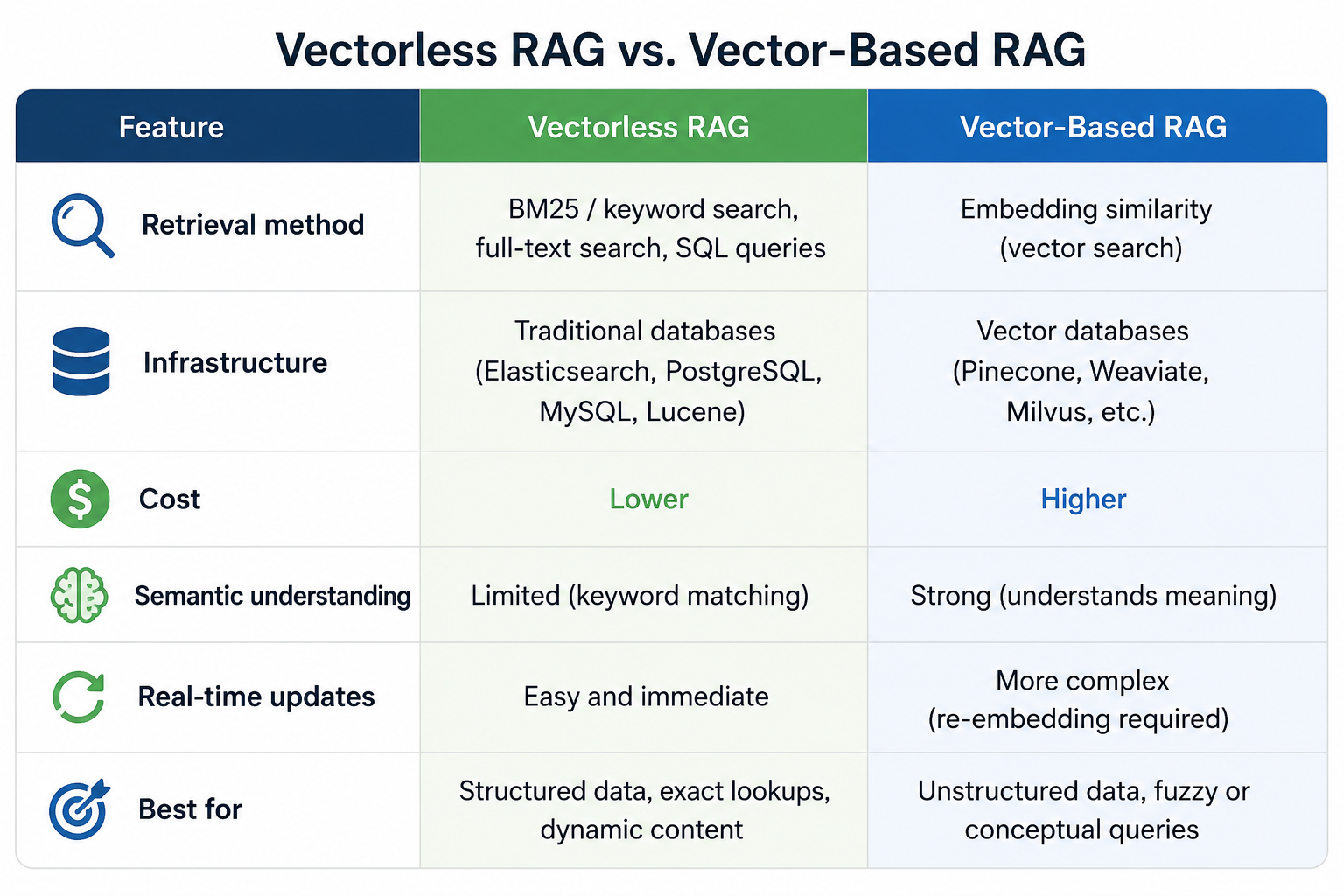
Vectorless vs. Vector RAG: A Decision Framework
It is easier to decide between the two approaches if you consider specific criteria.
Data type. Vectorless retrieval is very good for structured or keyword-dense content. Vector search is better suited for unstructured and semantically complex documents.
Scale. Small to medium document corpora are efficient and fast with lexical retrieval. The optimization built into vector search engines is leveraged by huge, diverse enterprise-scale collections.
Frequency of updates. Vectorless RAG has a clear advantage in knowledge bases which are updated daily or in real-time, as there is no delay in re-indexing. Vector RAG can be handled with infrequent updates and acceptable batch reindexing.
Budget. Vectorless RAG is attractive to cost-sensitive projects and startups as it runs on standard databases and keeps infrastructure bills low. Teams with the budget for managed vector database services have fewer constraints.
Query nature. Vectorless RAG prefers exact factual lookups (exact phrases, codes, known terms). For conceptual, fuzzy or semantically nuanced queries, vector search is preferred.
Setup speed. Vectorless RAG can get a prototype for a client or a hackathon live in hours. If you have the time and resources to build a mature ML pipeline, Vector RAG is a good investment.
The most sophisticated production systems usually combine the two approaches, with keyword retrieval for precision and vector search for semantic coverage. But the starting architecture is governed by knowing when each can stand alone.
The Right Tool for the Right Context
Vectorless RAG is not a universal substitute for vector-based RAG. It is a focused tool that thrives when terminology is exact, structure is strong, and the cost of complexity is high. In those settings, it delivers grounded, auditable answers with an infrastructure footprint that almost any team can afford. Understanding exactly where the approach shines and where it starts to crack lets you choose with confidence.
How Solwey Can Help
Solwey is an Austin-based software and AI innovation company specializing in enterprise AI orchestration, unified data intelligence, and custom software modernization.
Solwey helps startups and industrial midmarket companies move beyond dashboards by building secure AI agent systems that connect data warehouses to operational tools. Our solutions integrate Large Language Models (LLMs), Retrieval-Augmented Generation (RAG), and stateful multi-agent workflows to automate complex, multi-step processes.
Solwey enables organizations to eliminate data silos, enforce enterprise-grade security with SSO and RBAC, and deploy AI agents within governed environments.
By combining AI engineering, full-stack development, and enterprise security architecture, Solwey acts as a dedicated innovation partner for companies modernizing legacy systems and operationalizing AI at scale. Our team is committed to providing seamless support, ensuring that your software runs smoothly and your business runs more efficiently.
FAQ
How is vectorless RAG different from traditional vector‑based RAG?
Traditional RAG embeds documents and queries into dense vector spaces and relies on approximate nearest neighbor search. Vectorless RAG works directly on text indexes using lexical search (keyword matching, SQL). It removes the need for embedding models, vector databases, and reindexing pipelines, trading some semantic softness for transparency, lower cost, and real‑time updatability.
When should I choose vectorless RAG over vector‑based RAG?
Choose vectorless RAG when your domain uses precise, stable terminology (legal contracts, compliance, product catalogs, financial reports), your knowledge base updates frequently, your budget or infrastructure is limited, and you value interpretable retrieval logs. Vector‑based RAG remains the better choice for open‑domain, unstructured content where meaning is expressed through diverse phrasing and conceptual relationships.
What are the biggest limitations of vectorless RAG?
The main trade‑offs are weaker semantic understanding (synonyms and paraphrases are easily missed), noisier retrieval when keywords match but intent doesn’t, potential token‑wasting from less selective document ranking, and poor performance on highly unstructured or multilingual corpora. It also struggles with complex multi‑hop questions that require connecting ideas across different vocabularies.
YOU MAY ALSO LIKE
View all


Never miss anything!
Get weekly updates on the latest automation trends and design news.
Let's get started
If you have a vision for growing your business, we're here to help bring it to life. From concept to launch, our award-winning team is dedicated to helping you reach your goals. Let's talk.